For over 20 years, Simplygon has worked with developers to advance automated 3D content optimization. Developed in partnership with Xbox Game Studios and validated in AAA game development, we now offer Clustered Meshlets Optimization, a solution that transforms a single high-detail mesh into a continuous level-of-detail representation that adapts dynamically at runtime.
Instead of switching between a limited number of discrete LOD models, Clustered Meshlets decompose geometry into small, independently renderable meshlets and organize them into a hierarchical structure that covers the full range from high to low detail. This creates a GPU-friendly, error-driven LOD system that helps engines render the amount of geometry needed for the current view.
Meshlets are groups of triangles that function as self-contained rendering units. Simplygon analyzes the input mesh, partitions it into many meshlets, and then progressively merges and simplifies them into coarser representations. These meshlets are organized into a directed acyclic graph (DAG), where fine-grained detail exists at the leaves and simplified clusters appear as you move toward the root.
At runtime, the renderer traverses this hierarchy and selects an appropriate combination of meshlets based on camera distance, screen-space error, or performance budget. Because meshlets preserve boundary vertices, adjacent clusters fit together without visible gaps, even when rendered at different detail levels.
Clustered Meshlets are designed for GPU-driven rendering workflows. Each meshlet can be evaluated, culled, and rendered independently, making the technique well suited for modern mesh shader-based rendering pipelines. Simplygon outputs the metadata required to support this workflow, including bounds, error metrics, hierarchy relationships, and vertex ranges, enabling developers to implement parallel selection logic directly on the GPU.
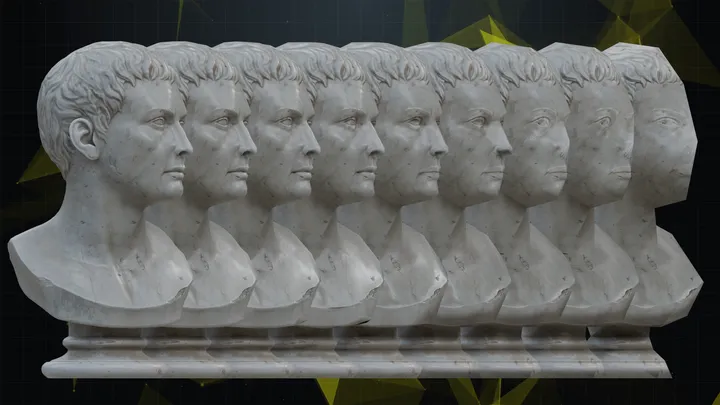
This approach is useful in projects that need scalable geometry rendering across a wide range of view distances while maintaining visual continuity. By replacing discrete LOD transitions with a continuous meshlet hierarchy, Clustered Meshlets help reduce visible popping and provide developers with more control over performance and detail.
Clustered Meshlets can be a practical option for teams building rendering systems around modern GPU pipelines and looking for a more flexible way to manage complex meshes at runtime.